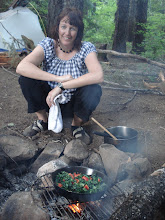
Sunday, June 14, 2009

Salami Day with the de Bortolis


Sometimes, the stars are just aligned, and nothing you do will stop the goodness coming your way. At least that's how it felt when food blogger and Twittermate @tomatom offered me the opportunity to accompany him to the de Bortoli family's annual Salami Day in the Yarra Valley. This came on the heels, by the way, of the wonderful @Ganga108 offering to ship some cookbooks she was clearing out to any address in Australia; mere days later Kylie Kwong's Recipes & Stories landed on my doorstep. The Twitterverse is an amazing land of plenty, especially if you hook up with your real community of interest. But back to Salami Day...

The day began before first light, as Ed and I followed our Google maps blue dot on the iPhone (well, technically the blue dot follows us, but on the return trip after hours of grappa and sangiovese, I was pretty sure we were following the dot...) up to the de Bortoli vineyards. Just as we pulled up, the sun having just risen, there was the pig, which had just been sawn in half. Within minutes, the head and other bits were on the table, where family members Maria, Dominique and Angelo set straight to work. (They had actually already butchered two pigs the day before, so were definitely in the groove.) There were only a dozen or so people around at this stage, including Darren de Bortoli (Managing Director) and his sister Leanne and her husband Steve, the winemaker and manager in the Yarra Valley. Just to prove what a small world Melbourne is, Stuart's dad's cousin Andrew Chapman was there taking photos for the family, accompanied by his lovely wife Josie.

As some headed off for their first coffee with a shot of grappa, Josie and I grabbed a knife each and helped shave the fat off the underside of the skin, which was then chopped up to be used for the cotechino sausages. The fat itself was a very pleasing smooth texture that felt scrumptious on the hands. These pigs had followed the strict diet for the last few months of regular acorn feasts, and the flesh was a beautiful dark pink/red as a result. In the adjoining area of the shed, another pig (not raised by the family) was on a spit for the sumptious lunch we would enjoy later... but we didn't have to wait long before platters of salumi and freshly made ciabattas did the rounds, closely followed by trays of grappa.

By this stage, Maria, Dom, Angelo and the local butcher had made great progress on the pig, having sliced all the flesh from the bones (except the hams, which were left intact to cure and I believe some for prosciutto?). The meat was in pieces about the size of my fist, at which point they spread it across the metal tables, added the spices (chili, fennel, salt, pepper, and saltpeter), and mixed it up a bit by hand. Next it was time to pop it through the mincer (and the need for a nice big electric mincer becomes readily apparent when you see how much meat has to be processed!).As more people arrived and the accordion started to play, the atmosphere got both more festive and less intimate. For someone doing a PhD trying to unravel the difference between Hage's 'cosmo-multiculturalists' (some would call them the 'foodies': people who are 'into' food for reasons of social distinction) and cosmopolitans (food + community = understanding, openness to cultural difference), the shift at this point was interesting. I felt enormously privileged to have been there from the beginning with the family, neighbours and friends, and had really enjoyed the easy comradery of the communal butchering.

After the mincing comes the salami stuffing. The previous day, they had made the salami with collagen casings, which are made from pork intestines, but reconstituted to get a more even and stronger consistency - hence those salami were quite straight and even as they hung in the cool room. Today they were using intestines (long enough to stretch round the shed!), so ended up with lovely curved salami, which Angelo expertly dipped in near boiling water, then tied up with twine to be hung.

I believe the main salami made would be described as sopressata from Calabria (but I could be wrong). There was some venison brought by the butcher that was also made into salami - apparently venison is too lean for a good salami (too dry) and so was mixed with the pork and fat. Finally the cotechino was made, requiring two times through the mincer with different blades to churn through the tough rind. Whereas the salami will be hung for about 6-8 weeks, the cotechino could be eaten immediately - I was told that you can boil it or cook it slowly for quite awhile to soften it up further.

The morning drew on towards lunch, by which time the crowds had really arrived and the wine was flowing freely. About a hundred of us sat down to a beautiful meal of pork sausages made the day before (to chef Tim Keenan's recipe, which has renewed my belief that there are really good sausages to be had in the world - yum!), served with wine soaked caramelised onions and grilled polenta with a salad of mixed greens and vinaigrette. This was followed by a beautiful array of cheeses and that fresh ciabatta again. I enjoyed the charming and interesting company of Darren de Bortoli over lunch, and we conversed for hours on his family's history, community, cultural diversity and cosmopolitanism in Australia (with a few forays into American politics and friendly disagreements over Howard).

As the afternoon waned, the conversation moved from kids' lunches ("We used to be weird for our salami sandwiches, now they're so common the kids say they're boring and want sushi! Sushi, for God's sake!"), to the resurgence in interest in the 'old ways', such as the salami days. Darren made the point that even the 'skippies' are into it now, and someone laughed that "people are calling them 'foodies', when all they are is wogs!" There was much talk of how the southerners (Italians) maintain the salami day tradition, with the requisite grappa, wine and sociality, whereas the northerners have the salami day, but just get in, get the job done, and get home again. This 'northern/southern' discussion was from people who were third and fourth generation Australians, yet still maintained their regional distinctions here in Australia. Fascinating!

Alas, it was time to bid the generous de Bortolis grazie e arrivederci, and follow our blue dot back into the city, where the children and Stuart had excitedly prepared us a three-course meal (not realising I would be too full to eat much!). I look forward to a sausage making day with the children one day soon in our own attempts to nurture our community with food and ritual.

Wednesday, May 27, 2009

From White Australia to Cosmopolitan Melbourne in 40 years: really?

The recent coverage of Sol Trujillo's parting comments that Australia is a racist country, in fact, 'backwards', has got me thinking. Here I am, writing a paper about the ways in which Melbourne is or isn't cosmopolitan and how I'm testing that question via Melbournians' foodways, and Sol pops up and says he's found the country racist.

The media have been typically inane in their coverage, and the sound bites from members of government have been similarly disappointing (in that horribly predictable sort of way). No matter what one thinks of Trujillo (and I'm sure many people have rather strong sentiments about the former CEO of Telstra), and further no matter what his motivations are for making the allegations now, as he unhappily departs, the issue remains that a Mexican-American claims he has suffered racism in this country. He may or may not be 'right', so to speak, in that it's entirely possible that nobody who made him feel he was being singled out for his race in some way actuallly meant to, or harbours any racist sentiments. Then again, to suggest Australia is devoid of racism is high farce, and you may as well join the ranks of Stolen Generations deniers like Andrew Bolt immediately. Of course there's still racism in Australia, as there is in America, China, England, and everywhere else in the world. Why would Trujillo not have felt some of that? Dismissing his claims so snottily, as have the politicians, seems permissible because he's such a figure of power, but do we want to be those revisionists? I don't.

Imagine if the claim was from a well-respected academic, say, Ghassan Hage, that Australia still harbours a great deal of racism. Oh, Hage has made that claim, and still is in many nuanced and polemical ways (yes, I believe you can be both nuanced and polemical). And Hage gets mixed responses, it seems. What about a woman making claims of sexism in the workplace? She'd probably be told she was imagining things, if my experience of Australian reception of such critiques is anything to go by.

Is Australia 'racist' and 'backwards'? As a national imaginary, I certainly believe we are not such a place anymore. The top-down rhetoric since Hawke and Keating has been that we are a multicultural country, a tolerant nation, arms wide open. The bottom-up response certainly seems to be increasingly matching that hopeful national imaginary, though we will never be rid of division and unfortunate habits of essentialising Others, no matter who 'we' are. Trujillo probably rightly perceived that he was sometimes marginalised by (especially the more homogeneous white, middle class) Australians who were unaccustomed to cultural diversity in 'their' territory. I'm sure most of them didn't mean anything by their behaviour - but the folks he would have been with would probably be better described as cosmopolitan capitalists than cultural cosmopolitans.

How far have we come since the White Australia policy was officially repealed in 1967 (though not operationally until about 1973)? It's not that long ago, really. The people who supported that different national imaginary are not just still around, they're largely running the country at the moment. Is it any wonder that the World Values Survey is finding that with generational change comes higher levels of cultural cosmopolitanism - expressed as a belief of 'belonging to the world'. Perhaps if Trujillo sends one of his children (does he have children?) back to Australia in another five or ten years, they'll have a different story to tell. In my 16 years in Australia, I've found it to be increasingly diverse and comfortable with difference, but then, maybe that's merely a reflection of either a) I moved suburbs or b) I want to believe the cosmopolitan version of us in order to reify my own sense of myself as cosmopolitan. Hence my project of interviewing a broad cross-section of people in terms of age, ethnicity, education, income, etc is so important - to stop all these (stupid) common-sense claims about what Australia 'is' or 'isn't'. Now to write that paper...

Sunday, May 17, 2009

The Great Pho Party '09

So I'm back. Hopefully this blog will come alive again now that I'm back to focusing on food and identity full time in my PhD (after a manic year off as a worker). But on to the real story...

Last weekend, to celebrate receiving a scholarship for the rest of my PhD (yay!!), I invited about 20 of my friends and family who have been through the first couple years of my part-time student/mother/worker struggles with unfunded study. Most are fellow students, all are lovely, and most also really like pho (Vietnamese noodle soup). (N.B. I know I should use diacritics, but am too lazy to go copy them and paste them here, so indulge me.) I had never made pho before, though in a cooking class in Saigon I was shown the basic method for pho bo (beef pho). As the grateful recipient of a lovely big 15L stainless steel pot for last summer solstice, what better way to use it than to make pho for loads of people? Well, you'll see that my lovely pot wasn't as big as it seemed...

Friday morning, Stuart and I wandered dreamily through Minh Phat (Vietnamese grocery off Victoria St, Richmond) gathering crucial ingredients, then over to a fruit shop for a few missing herbs (esp. sawtooth coriander) and finally the butcher for the meat and bones. I first asked for 4kg of shin bones and was told they didn't have any. Weird, huh? I accepted this bizarre response and asked for 4kg of flank, which I got (and realised was A LOT of meat!). I then asked for 1.5kg of topside, whereupon the woman serving me lfinally ooked quizzically at me so that I said, "I'm making pho". She appeared quite excited about this and thrust a bag of beef balls at me, insisting I needed them too. Sure, why not? Finally, she asked me to wait, rushed out back and dragged a huge bag of bones in, pulling four out and telling me, "for you, no charge today." I was delighted (and she clearly was too - I guess not many Anglos pop in to get ingredients for serious quantities of pho - and I think she must originally have thought I wanted their bones for a dog?), thanked her graciously, paid for the rest (only $47 for all that!) and then Stuart and I lugged our 10kg of meaty goodness back to the car and rushed home.

Dearie me, I wish I'd started the stock earlier, but I think I had extra bone, which made up for a slightly too short cooking time... so now it's 11:30am, guests will arrive at 7pm, and this stock wants a minimum of 6 hours...

Method & Ingredients

Remember, I was cooking for 20 (and ended up serving 25, with plenty of ingredients except the rice noodles, which ran out for the last 5 of us, but I had some dried to make up the shortfall).

4kg shin bones
4kg flank, cut into pieces about 15cm long
1.5kg topside, sliced thinly
4-5 brown onions
8-12 shallots
2-3 bulbs ginger
6 cinnamon sticks
12 star anise
4 brown cardamom pods
6 cloves
1/2C salt
1/2C sugar
1/2C fish sauce (buy a good brand, which should say "Nuoc Mam Nhi" - any from Phu Quoc are great)
4kg fresh rice noodles
spring onions, finely sliced
sawtooth coriander
coriander
bean sprouts
Vietnamese basil
chilies, sliced
lemons, quartered
chili paste
hoisin
nuoc mam cham (dipping fish sauce: fish sauce, lemon, garlic, chili, sugar)

First, take your bones and soak them in warm water with lemon juice and a generous pinch of salt for about 1/2 hour. This starts to release the blood so you will get a clear stock. Then pop them into boiling water for a further 5-10 minutes, before transferring them to your stockpot full of boiling water. I put them into my 15L pot and simmered them there for about 3 hours, skimming the scum off the top frequently.

While the bones are simmering, lightly bash the cinammon, cloves, star anise and cardamom to break them into smaller pieces, then dry roast them for a few minutes in a (preferably cast iron) frypan (to release more of their oils before adding them to the stock). Put the spices into a muslin bag and drop into the stock.

Next, hold the onions, shallots and ginger over an open flame until chargrilled and set aside to cool. When cool, pull and rub the blackened skins off, cut the onions in half, and pop all of it into a muslin bag. Add these to the stock after about 2 hours.

Next, you're going to add the flank to cook for 2-3 hours. This is when I realised I needed the bigger pot. Stuart dragged his brewing pot out for me, which is about 40L - it takes up 2 burners but does the trick. :-) Add the salt, sugar and fish sauce now. After 2-3 hours, pull the flank back out, pop it into a baking dish with some of the stock and leave to cool.

Once the stock has been simmering for about 6 hours (you can definitely go longer - this is a minimum), pull the bones and muslin bags out and strain it through a piece of muslin into a clean pot. (I was able to put it back into the 15L pot at this stage - and I had added some water when I went into the big pot.) Did I mention that it's very very helpful to have a second person around when you're making this much pho? Stuart was very helpful and appreciated!

Your stock is ready! The flank should have cooled, now you can cut it into bite-sized pieces (and I removed a lot of fat whilst doing this - very happy chooks Saturday morning!). Taste the stock and adjust seasonings if you need to with salt, sugar or fish sauce. It's also common in Vietnam to adjust with msg or 'pork powder' or 'chicken powder', which are msg-free stock powders (Knorr is a favoured brand in Saigon). I was very happy that I had no need to add any.

As guests are ready to serve, have your flank in one bowl, the topside in another, a pot of boiling water next to the stock, and your rice noodles ready to go, as well as your array of plates of herbs, lemon, bean sprouts, fresh chilies, and chili paste and hoisin. I used Stuart's brewing sieve to dip the noodles into the boiling water to heat and soften them before placing them into a bowl. Next, I added the raw sliced topside, then boiling stock, then flank pieces before handing the bowl to the grateful recipient to add their own herbs, etc. Voila!

My favourite comment of the evening may have been, "I'd pay $8.50 for this" from a Vietnamese Australian friend, though I did also appreciate, "it tastes just like real pho in Saigon", even though much of my theoretical work thus far has been contesting notions of authenticity and its instability as a category, let alone its essentialising tendencies... I guess the point is that we all agreed it was rather delish.

I think next time, though, I might cook it for just 10 people!

Tuesday, March 17, 2009

The Day of the Xray


The day of the x-ray

I awoke, delighted to be alive

Alive to be delighted.

The day of the x-ray

I read about the bushfires

While the fires knew nothing of me

The day of the x-ray

I had no expectations

I was not subject to disappointment

The day of the x-ray

The path eluded me

So I paced it quadruply

The day of the x-ray

The resident evil arose

Undefeated by reminders and requests

The day of the x-ray

It was still broken

And I am still whole.

Sunday, November 23, 2008

The Market Crash 2008: How I was left without a leg to stand on


Dreamy dreamy Saigon. Wandering surefootedly through the many fabulous markets, grazing a bit here and there on banh mi and rambutans. Dictating notes to myself on my spanky new digital recorder in the giant supermarket (Coop) – oh wonder of wonders (can you believe the special stock cubes for pho are just salt, sugar, beef powder, garlic, onion and msg? What about the ginger, the star anise, the cardamom, cinnamon and cloves?). A glorious start to my eight days for research in Saigon. Until…

I rounded a corner slowly, gazing at the next row of brilliant greens and browns, and suddenly my ankle rolled over an unexpected dip in the pavement of approximately 4 inches (picture ankle hitting the lower ground before the foot, if you can) and I felt a 'pop' as I caught myself on a stall and kept from falling. I stopped, leaning on the table, and watched along with a small crowd as what appeared to be the top of a bottle cap came immediately swelling from just below my ankle (very 'Alien' moment), to quickly morph into more of an emu egg. Using labour breathing to cope with the pain, I tried to work out what to do as some locals brought me a chair, someone applied what I suspect was tiger balm and another applied ice.

A kindly cyclo driver helped me hobble into his vehicle and dashed me off to what he kept calling the 'hospital', which was in fact a pharmacy. He cycled me straight up to the counter, where they looked at the egg on my foot and my horrified expression and shoved a handful of pills and instructions at me (they were anti-edema, muscle-healing and other assorted oddities) for a grand $4 before the cyclo driver took me home to my friend Billy's.

Fortunately, Billy's housemate Brigid was home, and she took me immediately to a western medical centre, where I was given codeine, an x-ray, sent to a local hospital for a catscan (very cool pictures) and crutches. I returned
the following morning to have a cast put on after the swelling had gone down some. The catscan shows a small fracture of the left lateral colloide, which is just above the far left metatarcel on my left foot. It’s actually a small piece of bone that’s broken off said colloide, as opposed to broken in half. I’m told the body will absorb the piece eventually. I think I should suck some marrow.

So my trip is now definitely more focused on conducting interviews with a raised foot than market wanderings and musings, which may be all for the best anyway. In fact, I went straight from the doctor's to my first interview – can’t waste any time or money! Crutches, which I suspect are pretty awful at the best of times, are a true art on the uneven roads of Saigon. And my first pair were craptacular pine, which split last night when somebody knocked them over. I have now upgraded to very flash metal crutches. My arms are getting past the soreness that comes with supporting yourself for days, and my right thigh is rippling muscle. Don’t ask about the left leg.

For those interested, the market crash hurt like hell. We won't speculate about whether there's damage to tendons or ligaments until the cast comes off in about a month, for fear of a depression. A single quarter of negative growth should teach me to live within my means, and to keep my eyes on the ground rather than the horizon.

Monday, August 25, 2008

Sanctity of the bean

"Espresso is a polyphasic colloidal solution prepared with 30 to 40 milliliters of water at a temperature of 90 to 96 degrees C in 25 to 30 seconds."
The following is a true story of a recent interaction I had at Plush Fish. Names have been changed to protect the ignorant.

Me: Strong latte, please.

Checkout chump: Small, medium or large?

Me: No, I said I want a strong latte.

Cc: Sure, but small, medium or large?

Me: Well, a strong latte has two shots of espresso and an equivalent amount of hot milk, so you tell me what size that is.

Cc: Um, so you want a small?

Me: Yep.

Cc: Um, sugar with that?

Me: (silence and slight smirking direct gaze)

Cc: Won't be a minute.

Now, I know it isn't this guy's fault that the cafe has decided to introduce sizes to increase their margins by offering more milk, but I'm here to do my bit. ;-) And by the way, Starbucks just pulled out of over 60 stores here in Oz 'cause we just don't like 'em. Power to the believers in the purity of the bean! :-D

Wednesday, January 09, 2008

Cartesian Kids


We're in the kitchen, kids at the table, me at the butcher's block. Atticus announces that he will be unable to do something, as 'the boss' won't let him do it.

Me: "Who's the boss, sweetheart?"

Atticus: "The boss is my heart!"

Me: (melt, grin)

Antigone: "My brain is my boss!"

Me: (whoa, philosophy starts young in this house, and what debates we'll be having at this rate!)

Oscar: "Well, I'm the boss of both my brain and my heart!"

(This last is especially typical of Oscar, who actually argued with me in his sleep while camping when he sleep-talked, and I said, "go back to sleep, Darling, you're dreaming," to which he responded, still asleep, "no I'm not!" then promptly laid back down and slumbered on.)

Tuesday, November 20, 2007

Melancholia awaiting intervention

melancholic drips of
sweat
mingle with sea tears of
joy

salt, sweet, spice, sour

a bowl of pho
a slice of lime
and the healing heat
of too-mild chilies

cardamom, star anise, cinnamon, cloves

bitter
sweet
aromatic
numbness

crunchy oiliness of banh xeo
wrapped in the nosy spice
of mustard leaves
pungent with the aniseed of
holy basil

contrasts
no spice without sweet
no salt without sour

home is where the contrasts
burn holes in my heart
the better to allow fateful winds
to blow me apart
with ecstasy, doldrums and easy pleasure

So long Sài Gòn.

Thursday, November 15, 2007

Ghettos and calling the kettle black


I’m sitting in the backpacker ghetto in Sài Gòn, trying to tempt my sore tummy back into the realm of the well by tenderly offering it ‘comfort food’. I’ve tried countless fruit shakes and lassies, pumpkin wontons in coconut soup, and goat’s cheese salad so far, plus a number of plain baguettes, all to no avail. I cannot face any noodle dishes (except pho), spring rolls, grilled meats or anything I devoured in the lead up to my belly’s demise. Is this irritating? Supremely. Do I think I can fight it? Not even going to try. I accept my need for cultural succor in the midst of an otherworldy month in Southeast Asia. Here I am studying the foodways of Viêt Nam, incapable of consuming any more of them, at least for the time being. Yet this has led to what I am finding a very interesting reflection.

Normally when we travel, Stuart and I are slight food fascists – not only do we try not to eat Western food during our travels (except a selection of breakfast foods, which we indulge), we scorn the idea of traveling in a country and not wanting to eat their food. Among the many reasons for our stance on this is the idea I am working on in my thesis about food being an avenue to understanding and belonging to a culture. So we try to eat our way to understanding, so to speak. Some would say we are ‘consuming culture’, though I am increasingly at odds with that concept. Culture is not a consumable, it is an interaction. And food offers a rich opportunity for this interaction – that is, over the table.

In fact, another brief reflection on my own life that I’ve had this trip is how I don’t eat nearly as much or as well when I’m alone (which is common to many people), and I have often subsequently wondered about the legitimacy of my food interests given my propensity not to eat or to eat very simple foods when alone. I have realized that my interest in food is as much about an interest in community as it is food (though I do, of course, adore good food), and so when there is no community, no table to share with friends and family, food is no longer a primary concern.

But back to the main topic here, about me sitting in a backpacker ghetto eating Western food in Sài Gòn. What am I doing? Why am I not out there, eating more banh xeo and chatting with locals? Well, aside from being sick, I think many of us are gathered here because we need some cultural succor as well. We need linguistic and cultural familiarity, and sometimes just food we recognize. It’s all very exciting and wonderful to be challenged hourly by new foods, drinks and the environments in which they are prepared and consumed. It is also a constant de-centring – it’s destabilizing. Those who have heard me on the topic of de-centring before will know that I am in favour of this experience, and find it worthwhile in the same way that learning to write in the margins enriches any reading of our lives. But such de-centring is also unsettling, and therefore eventually quite tiring. I think then that people need a recharge, and I am trying to come to terms with my own need for this supplement. And so here I am, in the ghetto.

Now, what I want to do next is talk about other ghettos. Migrant ghettos, socioeconomic ghettos, racial ghettos – the word has been used, mostly in a derogatory fashion, for some hundreds of years. The original ghettos were the Venetian Ghettos, where Jews were forced to live from about the 14th century. The term continues to apply to minority groups who either willingly choose to live amongst ‘their own’ or who are forced to by a majority group, usually through violent means. But even when the minority group that is willingly choosing to collocate with others of their group is relatively affluent, the term ghetto carries negative connotations. We need only read some of the more racist journalists or politicians to know that they ‘don’t approve’ of these ghettos or, as we often read in Australia, ‘ethnic enclaves’. Yet these same people typically also ‘don’t approve’ of new migrants moving into ‘their’ neighbourhoods. Catch 22. I’d like to focus on migrant ghettos, and I’d like it to be clear that I’m not using that term derogatorily, just descriptively.

Melbourne has a number of migrant ghettos, including Carlton as the original Italian area (which, interestingly, is no longer ever referred to as a ghetto as far as I know, though it maintains a very high population of Italian migrants – in fact, none of the Italian neighbourhoods are called this anymore, which makes me wonder ever more about the shifting notions of race in the geopolitical sphere, where Italians are now ‘white’ though that was not always the case). Some of the better known ghettos these days include Footscray and Richmond, where the Vietnamese have settled for the last 30+ years. Footscray’s ethnic diversity is broadening as many more African migrants settle there, but Richmond’s Vietnamese character is threatened by inner-urban gentrification as the wealthy buy in to its proximity and vibrant scene (which, ironically, will disappear like the other vibrant scenes that exist wherever migrants, artists, musicians and academics cluster when they are driven out by increasing prices). But for years, Victoria Street has been “Little Saigon”, a place for the Vietnamese outside of Viêt Nam and for the non-Vietnamese who want a taste of it (often literally, when they go there entirely for the fabulous range of restaurants).

For the migrants who choose to live together then – what motivates them? Obviously, everyone is different, but I think we can draw some generalities as I did for the backpackers above. Migrants seek comfort and familiarity in a place where every time they leave their own home they are in a linguistic and cultural mist. In fact, their own home may be of such different construction and layout, the occupants a very different, often smaller constituency, the sounds outside and inside so foreign, that even to be at home is not to be entirely ‘at home’. If you don’t speak the language of your adopted country, when do you get to relax? Is it any wonder that groups that are culturally and linguistically distinct seek to live amongst ‘their own’? Interestingly, we never talk about the migrants in Melbourne as ‘expats’, do we? But let’s talk about expats.

Hm, where do expats live when they go overseas? In ‘expat communities’, you say? Right, so… ghettos. Aha. Why do they live in these ghettos? Why don’t they assimilate? Why don’t they learn the language? (English-speaking expats are particularly well known for their failure to even attempt to learn the language of their adopted countries.) Why do they insist on eating all their own foods?

So. Ghettos. They make sense. They allow people to make sense of their worlds, and to be at ease while they do so. Of course it seems best if they come out of the ghettos and interact and learn about their adopted countries, and contribute some of their own cultural knowledge to the host countries. All of this is also assuming that coming out is an option. With no language, and particularly in the case of refugee migrants, where the support services for them to have access to language classes might be very limited, it can clearly be very difficult to leave the ghetto. For women, there is another set of concerns, whether it’s a Western woman in an Islamic country or a Muslim woman in a Western country, or some other configuration where the ways of the home and host countries are directly at odds. But where these particular hurdles don’t exist or can be overcome, surely we will all be better off if we make forays out of the ghettos until it becomes comfortable.

I think I’m feeling well enough for a short wander to the Ben Thanh Market, where I can practice some language and have a bowl of pho for lunch.

Tuesday, November 06, 2007

Even holidays need a weekend...


Our first tour, and hopefully our last, ends tonight. It has been amazingly full - of people, activities, learning and a sense of being overly protected. We have been spoiled, delighted, irritated and stimulated, usually all at the same time. So, a few highlights...

Cambodia (actually Kampuchea) is a remarkable country of friendly, resilient people who have endured a great deal yet still carry on with broad smiles and a proud sense of their long history. The Champa kingdom that extended so many kilometres south of Angkor was a marvel of ingenuity and creativity, yet only remains as the minority Cham people in Cambodia and the Mekong Delta region of Viet Nam. They're the only followers of Islam in the area, as far as we have worked out. The Cham reign ended as the Vietnamese just kept pushing south from their original homeland in the north until they had their current long skinny dragon-shaped country to themselves ('they' being some 90% Viet and 10% another 53 ethnic groups). Of course, they also endured 1,000 years of Chinese occupation and carry a strong sense of that influence even now, particularly in the north, and the final purge of the Chinese took place in 1978 in Hanoi, when the Communists forced them out. There's still a sizable population of ethnic Chinese (Hoa) in Saigon, though that city boasts a stronger Khmer influence culturally.

Back to travel banalities, though, a highlight of the cruise on the Mekong Pandaw was the morning they took us to the floating market at Cai Be (in Viet Nam) and then conceded to let the intrepid amongst the group (ie six of us out of some 40-odd) actually stay ashore for a couple of hours to wander around the market onshore. The floating market serves as a sort of wholesale market, whilst retail takes place ashore. And what a glorious early morning marketing scene it was! The abundance of fresh fruit and vegetables (think cassava, coriander and Chinese cabbages flanked by bananas, betel nuts and bitter melon) was matched only by the extensive selection of fish (eels escaping their oversized containers next to skinned frogs still hopping limply next to unskinned wide-eyed fellow prisoners of circumstance) - the fish section, by the way, that didn't smell at all because all the fish were still alive. Of course, the cages of rats for somebody's dinner were less of a highlight, but interesting in that exotically appalling sort of way. A divine breakfast of pho at one of the stalls-cum-cafes followed by our first Vietnamese coffee (ca phe - and excuse the utter lack of diacritics here as I am too lazy a the moment to cut and paste) topped off our idea of the perfect morning. And then it was back to travelling in the 'safety and comfort' of a horde of lovely people who made up for the stifling environment of this style of travel by sharing their fascinating, long and adventurous oral histories with us as we all wiled away the heat of the afternoon up on the sundeck.

Along with all the fascinating tidbits learned about these glorious ancient cultures by wandering amongst their foodstuffs and basking in their collective warmth has been the dark side we've witnessed in places like Tuol Sleng (otherwise known as S-21) in Phnom Penh, the high school converted to a place of torture for opponents of the Khmer Rouge. Whether it was intellectuals or their own party cadre they were torturing, the place is a scene of horror that reminds one of how dangerous people can be when power and fear intermingle in large doses. The nearby killing fields at Cheung Ek were peaceful in comparison, even with the tower of skulls imposing its intensely physical memorial in the centre. Approximately 2 million people died in the mere four years the Khmer Rouge were in power, in a country that only had about 7.5 million at the time, by execution, starvation and disease. How how how does the world stand by while these atrocities take place in our midst? How can we learn from our horrible mistakes of apathy and save future victims all around the globe from similar acts of genocide? I only wish I could begin to answer the questions of which so many of us are full.

The Cu Chi tunnels north of Saigon hold their own horror, as we confronted the reality that living in tiny airless spaces deep underground was actually more appealing than attempting to survive the defoliated landscape above. While our American comrades have struggled to come to terms with their presence in this beautiful country that was so deeply damaged by their government’s actions (and ours, and both of mine, and who are ‘they’ and ‘we’… ?), the Vietnamese we’ve encountered have continually reiterated what a vibrant and dynamic country they are, and how no animosity lingers to hold them back in their drive towards peace and prosperity. Uncle Ho reigns supreme and I can easily accept him as the hero to lead us all out of the darkness of colonialism, imperialism and violence, even if only as a symbolic figurehead of idealism.

Sitting now in the sublimely colonial surrounds of the divine Metropole Hotel in Hanoi, one can understand the appeal of being the ruling class. Conversely, in such luxury lurks a cold divide from everything local, and sheltering in the cold divide is power’s old friend, fear. In the not knowing, in the protective gestures, and in the home-away-from-home creature comforts is where I sense that which seems most destructive – the fear to engage. If you strip back all this protection, these buffers and masks, people will quickly discover that there is nothing to fear, and that there is much to be learned. Tomorrow, when the others depart, I look forward to slipping out of the silk robes and into something a little more comfortable.

Friday, October 26, 2007

Angkor Hot!

Oh, my, the days of travel without children! We do so much! The last three days have been very full, fulfilling and diverse…

Wednesday we did the cooking class in Bangkok at Baipai – what a delectable experience that was. We learned the relative merits of tapioca over corn flour, how to make our own fresh coconut milk, and a particular favourite, how to make tom kah gai, the world’s best soup. We were taught to slap your mashed fish mix to make puffy fish cakes (Stuart, oddly, apparently didn’t do enough slapping…), that the predominant flavour to emphasise in tom kah gai (chicken galangal soup) is sour (the others being sweet, salty & spicy) and you don’t even have to cook the chilies, just bash them a little and pop them in at the end, and that the best way to check if your oil is hot enough for deep frying in the wok is to put a wooden skewer in and wait for bubbles. Oh, and we ate… mmmmm.

A classic Bangkok Bladerunner-esque cab ride along the raised tollways back to the Novotel Suvarnabhumi landed us in style on the biggest bed we have ever had the pleasure to enjoy. I think it was nearly twice as big as our king back home, and we slept like angels in the so-called city of.

Yesterday was the surreal meeting with our fellow tourists of the National Geographic Expedition which we are now enjoying, with an early flight to Siem Reap, gateway to Angkor Wat. Siem Reap itself is a bizarre American outpost with an army of smiling Cambodians providing for our every need. The Grand Hotel D’Angkor, built by the French in 1929 and refurbished and upgraded in 1998, is a palatial and gracious remnant of the recent colonial past, overlayed with the intense consumerism (and associated prices) of the current predominance of American clientele. But as is always the case with Americans (and I can say whatever I want about this, since I am/have been one), they are all so nice. And as for those on our tour, they are well-travelled, mostly quite socially conscious and very interesting people. Mind you, most of them are also well over 65, and I’m pretty sure some are pushing 85. Stuart, Jodi and I are the novelties on the trip, but as usual, everyone is delighted to see us traveling with Ma and Dad, and indeed it is a pleasure and a privilege to all be together (we just miss Rhett & Shari!).

We’ve visited Angkor Wat, Angkor Thom, the Bayon and today, a silk farm and artisan’s collective, and it has all been predictably gorgeous and inspiring, except for the crowds. We are not only traveling in a serious horde ourselves, everywhere we turn, we encounter ourselves exponentially. This does, unfortunately, have the effect of dampening our meditative capacity at these ancient ruins, but the temples are sufficiently incredible to sustain us. We do look forward to embarking on the boat tomorrow, in hopes of a bit more reflective space…

As for Cambodian (or Khmer) food, we finally had a beautiful meal of it today at Viloth’s in town. The green papaya salad was a perfect balance of sour and salty that we so adore (though it could have used more spice, as everything here is devoid of chili to please the westerners), the Amok fish (in coconut milk, lemon grass, basil and coriander) was an amazingly creamy yet delicate flavour sensation, and the Laab (minced pork, lemon grass, lemon, peanuts and coriander) was just completely out of this world – heaven. Tonight who knows how the food will be, but it is meant to be Khmer, whilst being enchanted by a performance of the celestial apsara dancers. I hope I find myself in about an hour exclaiming “nih ch’ngain nah” (this is delicious!).

Tuesday, October 23, 2007

Bangkok Chinois


One night in Bangkok makes the... Mama and Daddy relax!! Missing the kids at the moment is not so pathological as the anticipatory dread I experienced pre-departure (anybody suprised by this?). Phew. So, on to the blogging...

Bangkok is pretty fabulous, with the heat, the smells, the crowds and the ultra-delicious food everywhere. With the time difference, we were up at 6am for a bit of reading before brekky (how utterly luxurious in itself) and out onto Yaowarat Rd by 9am. A short stroll through lane after lane of markets led us to the Chao Praya River, where we hopped on a boat up to the Grand Palace. Of course, we had no intention of visiting said palace, but it was a lovely stroll through countless stalls and markets just behind the palace. After some glorious produce markets, we passed through the colourful flower market, before finding ourselves in retail central. When that grew tedious, we started to graze, landing eventually back in Chinatown for some pork buns, dumplings and wontons. Mmmm.

Fish, fried, dried or fermented, is definitely a local favourite, and the smell of naam plaa (fish sauce) is growing on us by the minute. Of course, although we've resisted most of the retail therapy, we have weakened over one or two irresistible items for the much-missed brood...

We're currently sheltering from the 45% humidity in the heat of the afternoon before venturing out for a Singha, som tam & gaeng kiaow on the River later this afternoon/evening... Tomorrow we're booked in for a half-day cooking class before joining the National Geographic folks at the Novotel Suvarnabhumi by the new airport of the same name. It's pretty rough, I tell ya'. And we're just the people to appreciate it.

Sunday, October 21, 2007

SE Asia or bust

It's been nine years, three kids, one vasectomy, two degrees, countless hairstyles, two overseas moves and a couple of breakdowns since our last extended childless adventure o/s, and it's time. We've been looking forward to this since Dad offered it a few months back, maybe even since around 2001? But now that it's upon us, I can't believe how hard it actually is to go. The kids are despondent, our friends and auntie & uncle are all set for support, and we really need a holiday, but ouch, this is hard. I just really wish we were taking the kids. I'm sure I'll change my mind?

So the trip is 3 weeks for Stuart, 4 for me. Two weeks from Angkor to Ho Chi Minh (Saigon) then Hanoi with my generous Ma and Pa and sister Jodes, then hopefully to Hoi An for about 5 days on our own (if it's flooded, we'll reroute...), finally to Saigon again, where Stuart will head home to lovely chaotic kiddles and I'll stay on for a week for research. I do have the best research ever, being forced to hang out with people while they shop and/or eat and talk about food, family, memory and imagination. Tough gig.

One glitch though - Stuart was told on Friday that he has to go to Singapore for a meeting on his way to Bangkok, meaning he's leaving in about an hour, whereas I leave at 1pm tomorrow, so we're hooking up in the Bangkok airport. Not only is this unfortunate for the whole 'first exciting/scary long trip away from wee ones' bonding on the plane, it means I have to be the one to drop kids off at school in the morning without him, whilst they dissolve (and I... ?) and I march valiantly away to get a cab to the airport alone. I know that some folks will be thinking, "yeah, but at least you're going overseas together(ish)", but the physical act of leaving the creatures I grew is the single thing I am dreading most, and now, I'm on my own.

Okay, off to a jaw-clenching sleep before the dreaded separation, followed by, I'm sure, an amazing holiday. Hopefully the next post will be a bit more exciting...

Monday, October 08, 2007

Social rhymes with show-all (at least assonantly)...

I'm thinking a lot at the moment about stitching my identities together, some of which have frayed edges and others which sport bias(ed) bindings. In this cyber-real unreality of the uber-E, where 'e' is for 'eccentric' and 'eclectic', my careful stitches sometimes appear as pure pastiche. And isn't it fascinating that when one finally mends the online schisms, puts that personality that used to make so much sense back into one eager little portal, how schisms show up as schizoid - we aren't meant to put all our selves back together again. Identities are so fractured, so multiple, that to force them back into one mould simply breaks it. So what the hell am I talking about? Well, it's this:

I really like having a blog for my musings, a wiki for food reviewing with friends, RSS feeds for journal alerts and blog updates (especially food blogs), email for the banal dailies, websites for designing online curricula, social bookmarking for online convenience and bibliographic trails, online data storage to tame my version-control issues, and social networking for making links (both academic and otherwise).

I have to go to a meeting. I'll be back. x

Sunday, April 15, 2007

Flag F(l)ag Football

It's hard to remember how annoyed I felt about that restless legs thing - I've been far too occupied and amused to bother thinking about foolish people lately. Picture this:

Boston, Chandler Inn, South End. Not the Hilton (where we stayed in DC), but clean and safe. Pop in at the bar downstairs for a drink after the Radcliffe conference on Thursday evening. Stop at the door. Ask doorman, "Are women allowed in here?" as my mind swam in some sort of anachronistic sense that in Boston they don't let the women drink in public. "Sure," he says, "more might come later." Weird, but okay. Sit awkwardly at bar amongst sports fans and wonder what tenacity I possess to keep this up. Order a local beer (boring - Samuel Adams). Pull out shield of notebook and begin to take notes on travels thus far. Men ordering drinks next to me mostly don't look at me, unless with a slight frown. Take note of stereotypical intonation patterns and abundance of white wines, light beers and martinis. Ooooooh, I get it (duh - bit slow). Confirm understanding that I'm in a gay bar with a nice young man, Anthony. He's very warm and invites me to join them - I say I will in a moment after finishing a bit of writing. End up having a drink there with Anthony and other lovely guy, who then take pity on me and take me to a straight bar a block away, where we share quesadillas, Australian slang and many laughs before I climb into bed around 10:30pm. Noice.

Next night after the conference: in search of a light dinner and a drink. Revisit straight bar from night before, but too crowded to sit down, so move on. Head for Butcher Shop, recommended by random man on train earlier. No seats. Cross the street to Oysters, recommended by couple in first overcrowded bar as good venue next to the Butcher Shop. Get the only single seat at the bar. The menu has 40 regional choices of oysters. Ask for advice from obvious local next to me. Obvious local turns out to be Charlie, the owner of the restaurant as well as of the Butcher Shop across the street, as well as a fine dining establishment in Beacon Hill. Charlie and his friends graciously keep me company, ply me with expensive wine, insist on buying my dinner (beautiful oysters, calamari, buffalo shrimp, soft-shell crab, etc amen), and then whisk me off to meet his wife the fab chef in Beacon Hill over a Laphroaig. What a gentleman!! What a gorgeous way to spend my last night in Boston! I love Boston!! Thank you, Charlie!

Now in New York with my beloved and Graham and Janine having a lovely time in spite of the wet, chilly nor'easter. Bought a fleece, gloves and hat in Boston - lifesaving devices all. It's real rain here too - like you really need an umbrella and everything. Crazy.

Wednesday, April 11, 2007

Restless Legs


Watching tv for the first time on this American dream, there was an ad. The ad was about "Restless Legs Syndrome", but it was actually about selling a drug for this unpleasant new syndrome. Hm, since when are restless legs a problem? Don't you just get up and go walkabout to sort that out? Aren't restless legs something people have talked about forever, the long skinny things that take people places, take people away, make us wander, encourage us to wonder, get us going, grooving, living, loving... ?

What is it about this place that makes people want to medicate restlessness, rather than interrogate it and fulfill it? Why drugs rather than the proverbial hugs, or drugs rather than simply getting off your non-proverbial arse and WALKING, which is probably all those poor little legs want? Of course, that's hard to do in ridiculous shoes, so maybe what we really need is a SENSIBLE SHOE REVOLUTION. I'm in. In fact, I'm already a card-carrying member of that movement.

So, Restless Legs. In America, you can take drugs to get over that. Me, I travel. Or I just walk or ride my bike at home. I don't keep sitting and wondering what's wrong. I suspect far too many people have forgotten about the natural world. The one in which it is OBVIOUS that if you sit and sit and sit allllll the time, you might (probably will) get RESTLESS LEGS.

So GET UP. Go for a WALK. Check out the WORLD around you. Use your body for what it was intended. Have more SEX. LIVE a little. Save drugs for plain fun (or not at all), but not to solve obvious problems. Duh. F*@#in' Restless Legs. S E T T H E M F R E E. pax.

Friday, December 22, 2006

Jonai Journaling

Warning: this may be intensely boring unless you already like TheJonai, and if you're not a fan of the 'annual letter' genre, stop reading now!

2006 in brief:

  • We moved from Malvern to Fairfield - Malvern is a conservative, wealthy, leafy suburb of SUVs and private schools where we either shopped at the Vic Market in the city for fresh produce or else slumped into Coles for 'necessities'; Fairfield is a 'gentrifying' suburb with a strong mix of working class and middle, Greek, Italian and Anglo, and nary an SUV in sight ;-) - we shop at 'our local Italian', Cardamones, or the next suburb's Piedimontes, plus still frequent the markets when we can.
  • Oscar attended Grade One at Fairfield Primary School where he learned to paint in the style of Fred Williams and helped create beautiful mosaics to brighten the schoolyard. Uniforms are optional (he rarely wears his) and the Principal knows all the children by name. He's one of the few kids who diligently rode his bike every day of the year.
  • Antigone went to 4-year-old Kinder at St Andrew's Kindergarten. She maintained her disinterest in the whole kinder experience all year, but dutifully rode her bike most days there, back, to pick up Oscar and back, a total of nearly 4kms.
  • Atticus was in a new Suzuki music class for the first half of the year, but opted out in the second half as he seemed to feel that he was too mature for most of the others.
  • Stuart went to Dubai & Germany and no longer wants to live in Dubai. :-D However, he does want more elegant and delicious 'work' dinners in Europe.
  • Tammi visited the Woods fam in California where she got lots of Hayden cuddles, alone time with McKella, Jianna and Maisie, and hours of warm and earnest sisterly confidences with Jodi. It was a week of family bonding with everyone down at the beach house Dad and Ma rented. On the final night, after witnessing Josh's deep fried extravaganza culminate in deep fried Twinkies, the siblings went out on the town and it snowed in Santa Cruz! She also got to enjoy a beautiful final sibling lunch at Chez Panisse, then stroll across the road to the Cheese Board to buy some bread and smelly washed rind cheese for the flight home. In the interest of national security, she ate the cheese in the waiting area instead of the plane.
  • Stuart moved offices (again) to the lower end of the city with a view of the Yarra. (Tammi's office has no windows.)
  • Tammi started her PhD in Cultural Studies at the University of Melbourne. Her topic is mapping multicultural foods and national identity in Melbourne. If all goes according to plan, you'll have to call her Dr Jonas sometime in 2010.
  • We all went camping at Tamboon Inlet for Easter and played on sand dunes.
  • Tammi worked for awhile at the School of Graduate Studies, where she was called "UnAustralian" by a colleague, the first time she'd experienced a truly nationalist slur in 15 years in the country.
  • Tammi attended the "UnAustralia" Conference in Canberra :-)
  • Stuart jetsetted to France where he madly pursued Le Tour de France alongside his generous host, Josh. He has not stopped madly riding about since.
  • Atticus began speaking in sentences. Most of them begin with "Me", as in "Me not like that very much" or "Me want somefing different." He is clearly a genius. :-)
  • Antigone began making books, cards and an endless supply of presents for everyone, especially Mama, who finds them on her pillow most evenings.
  • Oscar became a good reader and devours endless stacks of reference books about aeroplanes, boats, trucks, and spaceships.
  • Oscar perfected the design of a new rocket ship. Watch for his early sketches when he becomes famous (assuming his mother is organised enough to save them all). He and Antigone churn through a sketchbook a month on average.
  • Tammi started a job writing a website for coursework postgraduate students (on academic skills). http://courseworks.unimelb.edu.au
  • Stuart went to Dubai again and still doesn't want to move there.
  • Ianthe was our au pair for two creative and fun months before returning to Holland.
  • Inga was our au pair for two strong and delightful months of friendship before travelling to Darwin and working on a fishing boat. At last report she was in Cairns and we hope for a visit sometime in January.
  • Jade became our au pair and will hopefully remain an integral part of the Jonai for a long time. She brings equal parts warmth and discipline to the children's world and spends hours doing crafty things with them.
  • All of us began to walk, bike or take public transport everywhere.
  • We bought a Volvo, sold the HQ, bought two new bikes (Antigone & Tammi) and found countless more (Stuart).
  • Tammi went to India and Singapore, delivered her first conference paper, and ate herself silly (see blog entry below).
  • Stuart went to Nanjing and ate many fine banquets. He and Tammi missed each other at the Singapore Airport by three hours.
  • Oscar learned to skateboard, and had tennis lessons where he shows very promising natural talent.
  • Everybody became better cooks, but less frequent ones as Tammi worked too much.
  • We broadened our shopping horizons to the Preston Market, Cardamones, and Piedimontes, but haven't given up the Vic Market. Must go to Mediterranean Wholesalers to see what all the fuss is about.
  • Stuart and Tammi started systematically working through recommended restaurants around Melbourne (check out the wiki: http://foodcult.pbwiki.com)
  • Antigone learned to write the entire family's names without copying and can sound out most of the letters of the alphabet.
  • Tammi went to the "Everyday Multiculturalism" conference in Sydney and hung out with Penelope in Sydney's poor excuse for pubs.
  • We didn't go to Lorne enough, though the kids did with Ros and Wayne.
  • We camped at the Folk, Rhythm & Life Festival where we danced, swam in a beautiful quarry and played kid stuff.
  • We hosted many dinner parties and celebrated the equinoxes and solstices with dear friends and family.
  • We bought a washing machine - our first white goods purchase ever.
  • We loved, fought, laughed, cried and lived big all year... and that's just the short list.
  • May 2007 bring us all as much joy and exciting challenges!

Wednesday, December 13, 2006

Unbalanced approach to the solstice

Balance is not something one should seek too earnestly; equilibrium is statis. Yet in a brief period of equilibrium, one has a moment to feel calm, just before it all shifts again into intense growth, dormancy or some other organic, dynamic response to the world.

Today I am conscious that I am at work, at Melbourne Uni, in front of a screen in a mouse-maze cubicled windowless environment where the air is rife with paint fumes and the horizon is obscured. Only two days ago I felt uncertain whether I was in India, Singapore, Sydney, Canberra, camping in the bush or driving/flying/waiting somewhere between them all. Limbo lurking. The last six weeks have been outrageously unbalanced, even for me. I therefore find myself somewhat unbalanced as well, as in passionately mad. Racing thoughts and viscous verbosity are not helping. Nor is my highly caffeinated state. Thank the goddess the most unbalanced day is only a week away...


So last week I sp
ent some time in UnAustralia. What a maddening, exciting, depressing, horrifying and fun place it is. The dramatically dubbed Melbourne Massive formed a delegation of nine (okay, 11 when Tom & Susanna were around) at the CSAA conference in Canberra, the site of UnAustralia. As per some others' comments (see Michael, Glen, Mel G, Mel C, and Graham) the papers were a mixed bag of reflexive & un, challenging & not, interesting & dull. John Frow's final keynote was a definite highlight, which should have been the keynote in Parliament the night before, no offense Professor Ranciere, but John was political and incisive in the most 'resolutely rational' ways. Another key moment for me was the panel put on by the Asian Australian Research Network (AARN), who worked on hybridity, identity, politicians, food and art in truly interesting and engaging ways. Hats off to Simon Choo's work on food and identity in relation to the transnational flow story of the man who just wanted durian ice cream before he died.

I don't really want to dwell on the conference, but then, nor do I wish to delve into the intense social critique in which the Melbourne Massive engaged for five days running. I think good work was done by all and all our worlds have been usefully complicated just that little bit more. I certainly enjoyed the many pub conversations of the week. May I suggest some optimal follow up reading: Betty Friedan, Germaine Greer, Naomi Wolf and Susan Faludi come instantly to mind. ;-)

A quick recap then: car politics, rogue emails, grassy knolls & feral possums
got my shoe, group membership and mob mentality, OD'd on dismal food, J. Frow's wine, shiteful Irish pub and sterile Civic, Motel Girls at the Garden of Australian Dreams, abstraction and Australian Parliament, bedbugs, academic engagement and a broken fan. Hit it.

Today is the third of nine end of year/xmas do's in 13 days. Let madness reign.